[Machine transcription]
For we hold that one is justified by faith apart from the works of the law. You may be seated. In the name of Jesus, amen. Dear Saints, I think we’ll look at this picture. It’s a nice one, but we went right past it.
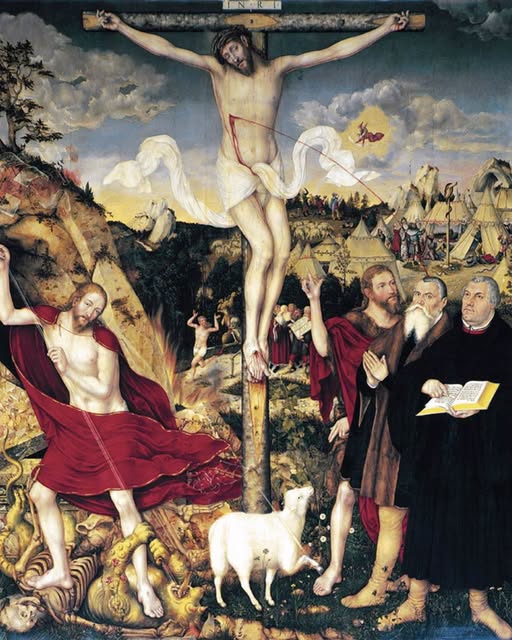
Remember, the Reformation was not only a matter of preaching and writing and publishing and singing, but also a matter of art. And we have at least three examples of this great law gospel painting from Lucas Cranach. He was the mayor of Wittenberg at the time of the Reformation and a friend of Luther in one of the most famous paintings.
And he painted a bunch of versions of this that we have in the middle of the bulletin, this allegory of law and grace or a picture of law and gospel. And I want to let this picture preach to us for a little bit because it’s preaching this apart that Paul mentioned in Romans chapter 3.

We confirm that a man is justified. apart from the works of the law. And that apart is really the entire argument of the Reformation, but not just, again, not just for 500 years ago, it’s also for us. So we’re looking at the picture, and we see that the main character, of course, is our Lord Jesus Christ, who on the right-hand side is not only being crucified, we see there in the middle, also raised from the dead on the right, And that’s my favorite, where he’s got the spear right through the mouth of the devil.
He’s also ascending into heaven. You see his feet disappearing off of the painting. But he’s also being incarnate of the Virgin Mary. You see the little baby Jesus flying from heaven with the cross on the way to the Virgin Mary standing on the hill.
So this is a picture of the second article, the Creed, that he is incarnate, that he’s crucified, buried, raised, and ascended into heaven. And then on the left side, there’s Jesus in the middle coming in glory, surrounded by the angels, the law and gospel, the blessing and the receiving and the sending on his right hand and on his left.
But the pain, so while Jesus is the center of the painting, really our attention is on this guy who’s in both sides of the painting, who’s the poor guy who’s just there in that loincloth. And on the left side, he’s having a rough day.
Here he is, the devil and death, the only flesh that the skeleton has is a tongue, wagging his tongue and driving him into the flames of condemnation and despair. And he’s looking back, not at the devil and death, but at the Lord Jesus who’s standing in judgment over him.
This is because of Adam and Eve. We see that in the background with Adam and Eve by the tree, eating the forbidden fruit and plunging all of creation, and especially us, their children, into this desperate situation. There gathered to the right in council together are Moses and the Pharisees, those teachers of the law.
and this is the confidence, the false confidence that the law tries to bring to us, that we can try to accomplish our salvation, but we see here, it’s simply impossible. Now compare the day that the guy is having on the left to the day he’s having on the right.
There we see our Lord Jesus crucified. There we see behind him the angels coming to announce to the shepherds his birth, glory to God in the highest. Behind that, we even see the picture of the crucifixion foreshadowed all the way from Numbers when the bronze serpent was lifted up in the wilderness and you see all the people who are being bitten by the snakes are looking to that bronze serpent and they’re being saved.
Most precious, we see Jesus risen from the dead and in glory trampling over death and the devil so that the same tyrants on the law side of the painting are now being stomped on by Jesus on the right side this is in fulfillment of the very first promise of the gospel in the very beginning when the lord said to Adam and Eve in the garden I’ll put enmity between you you devil and and her and your seed and her seed and he will crush your head while you crush his heel so Jesus by his death and resurrection has trampled sin, death, and the devil. He’s won the victory. And look at there, John the Baptist is the preacher preaching to this guy, and he has to use two hands pointing to the Lamb of God who takes away the sin of the world, Jesus on the cross, and the Lamb on the bottom.
That is his victory. And here, perhaps, is the most important part of the picture, which is easy to miss at first, and that is you’ll notice that there’s a dove by the side of Jesus. That’s the Holy Spirit, who’s taking this thin ray of blood that’s unnaturally flying out of the side of Jesus and landing right on this man’s heart. This is the work of the Holy Spirit, to bring the victory of our Lord Jesus Christ, to bring his blood, to bring his suffering, to bring his cross and his resurrection and bring it to you through your ears and into your hearts to wash and cleanse you from all sin.
This is the distinction between law and gospel. You’ll notice on the left-hand side, the tree which divides the picture on the left doesn’t have many leaves. On the right, it’s full of life. So the law, and this is what Paul taught us in Romans already this morning that the law reveals the guilt of sin. No one can be justified by works of the law because the law is that which shows us our great need for justification. The law is God’s great diagnostic that shows us our need for his help.
And the gospel is the way that the Lord saves us, the way that he rescues us, the way that he delivers us. Now this painting, just as a quick aside, This painting is two more times in your bulletin on the front and the back. It’s your homework to look at those.

Pastor Smith wanted me to point out, though, that on the one in the back, Moses is pointing also to Jesus, and that’s important because the Old Testament also points to Christ. And the one on the front is the same painting from a different angle, and Cranach, the painter, painted himself right into the painting, put himself next to Luther, and put the blood going right onto his head. It’s a beautiful confession of faith. It’s great. If you were painting it, you would too.
That Jesus is my Jesus, my Lord, and my friend and Savior. But why is this so important? Here’s why. There’s two things that we need to know to be saved. The first is, I mean, we would think that it’s obvious. It’s maybe not as obvious as it should be.
The first is that we need saving. This is the preaching of the law, which is the first work of the Holy Spirit who comes to us to convict the world of sin, to convict the world of unbelief, and to show us that we, in fact, do deserve the Lord’s wrath, that we do deserve his punishment, that we have fallen short of his glory. This, though, the thought that we’re sinners is pretty well known. I mean, in a way, every religion, every philosophy, every ethic knows that there’s something wrong with humanity, that there’s something wrong with us, that we need fixing.
But here’s the second thing that we have to know to be saved, and it’s that Christ is the Savior. Now, the reason that is so hard is because if we just know that we need saving, we think almost instantly that we can save ourselves, that if we need saving then we better get after it if sin is the problem then we better stop sinning if God is angry with me because of all that I’ve done wrong then maybe he’ll be happy with me if I can do something right in fact that argument that right there that this idea that if God is angry because of my sin then he’ll be happy because of my good works uh that’s uh there’s an old theological word for it. It’s called the rule of the law, and it’s embedded in each of our hearts. Because it turns out, and this is the amazing thing, it turns out that not only is there sin and corruption in our hearts, there’s also pride and a boasting in our own good works.
Remember the parable of the prodigal son, how the younger son was running out and doing whatever he wanted, and there was the older son who was obedient and stayed at home? Well, both those guys live inside of you, and you know that the younger son is wrong, that you’re not supposed to just do whatever you want and chase after your own lusts and desires and your rebellion and your anger and your greed and your laziness and your bitterness and all of it. We then when we, here’s the point, that when we get after it, when we try to, when we try to do better, when we’re actually trying to be good people and live a moral life, then the second error sneaks in and it says, oh, maybe, maybe I’m doing it. Maybe I, maybe I have done enough. Maybe I have achieved a resume that I can present to the Lord on the judgment day that’ll, get me in. It’s the danger of that little Pharisee that lives in your heart, that older brother that lives in your heart, that little monk that lives in your heart. Because remember, your conscience is either accusing or excusing. And it might accuse you when you know your sin, but it might start to excuse you, making the case for your own goodness. And that, it seems like, is what had happened before the Reformation. The argument had snuck into the church that we could by our own powers or by the grace that was given to us through the sacramental life of the church that we could that we could manage to present ourselves as somehow acceptable to God. And it wasn’t just by the way in Rome it was also in all of the other reactions to the Reformation that happened as well that we that we could by the Spirit make ourselves presentable to God that we could through the Spirit grow in such a way that we can stand somehow with God’s help, but we’re working together with Him. We can stand on the judgment day.
And here’s where the argument of the Reformation hits right at the important point for us also. And that is that there has to be an alone next to faith. There has to be an alone next to grace. There has to be an alone next to the Scripture. Not because the Scripture is the only place that we can find truth, or not because Faith is all by itself, or grace is somehow separated from God and the goodness that follows it.
No, but that we have to know that justification happens apart from the works of the law. That we have to go through this second difficulty of faith to know that we cannot, with our own efforts or by our own strivings, present ourselves to God. That’s a form of spiritual pride that has to be cast down.
That our hope is in Christ alone. Our salvation is in Christ alone. Our justification, our receiving the gift of the righteousness of Christ is through his word alone, and we receive it by faith. It’s a tricky thing. There’s a verse in Hebrews that says, Let us labor to enter his rest. that’s kind of a trick a riddle because if you’re resting you’re not laboring and if you’re laboring you’re not resting but this is the point that we have to work to not work we have to strive to quit striving we have to fight to give up the fight this is the theological work of the that the lord is calling us to over and over in the pages of the Scripture that we have to, you have to come to church and you have to listen and you have to believe the promises. I have to do it too so that we stop trying to save ourselves, to get into heaven, to achieve a righteousness on our own, but rather simply receive the gifts that the Lord has given, to believe his promise that your sins are forgiven, and to trust his word that he loves you and has given his life to save you, to cling to that with boldness, to cling to that trustworthy promise that Christ is, in fact, the Savior. And when that happens, when we’re striving to enter his rest, then we find ourselves alongside the guy in the painting covered with the blood of Jesus, washed by his blood, cleansed by his sacrifice, rescued by his work, justified apart from the works of the law through the work of our Lord Jesus Christ. So may God grant it. May God grant that this confession of the work of Christ against anything that we might presume to do, that that confession would find a place in our own hearts and that we would rejoice in the promise of our Lord Jesus, not only today, but also on the day that we stand before him. May God grant it for Christ’s sake. Amen. And the peace of God which passes all understanding guard your hearts and minds through Jesus Christ our Lord. Amen.